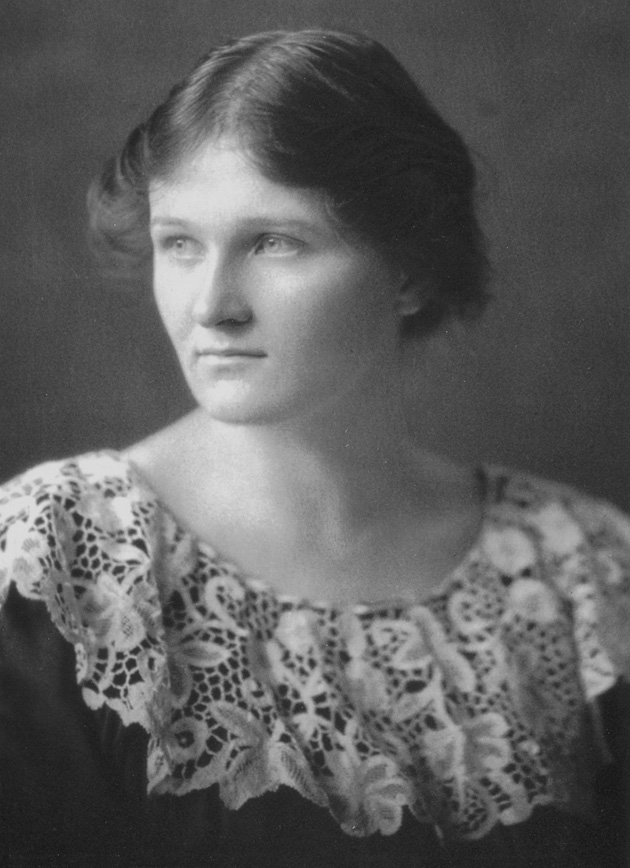
She was born Cecilia Payne in England, and in 1934 married Sergei Gaposchkin, thereafter also known as Cecilia Payne-Gaposchkin. Her PhD dissertation was said to the best one in 20th century astronomy. She became the first woman to become a full professor at Harvard.
She received her bachelors degree from Newnham College, England in 1923 and her doctorate from Radcliffe in 1925. She was the first person(!) to receive a Ph.D. in astronomy awarded either by Radcliffe or Harvard and she was the first person to receive a Ph.D. for work done at the Harvard Observatory.
Her dissertation, entitled "Stellar Atmospheres, A Contribution to
the
Observational Study of High Temperature in the Reversing Layers of
Stars," argued that the great variation in stellar absorption lines was
due to differing amounts of ionization (differing temperatures), not
different abundances of elements. She correctly posited that silicon,
carbon, and other common metals seen in the sun were found in about the
same relative amounts as on earth but the helium and particularly
hydrogen were vastly more abundant (by about a factor of one million in
the case of hydrogen). This result disagreed with earlier theories, and
when she sent a draft of her paper to Dr. Henry Norris Russell, he
replied that such a result was "clearly impossible." Russell had an
earlier paper which argued that if the earth's crust were heated to the
temperature of the sun the spectrum would look the same.
| H |
He |
C |
N |
O |
Ne |
Mg |
Si |
S |
Fe |
| 2400 |
162 |
1 |
0.21 |
1.66 |
0.23 |
0.10 |
0.09 |
0.05 |
0.08 |
Table : These are the relative proportions of numbers of atoms
compared to Carbon of the ten most abundant elements in the solar
system at its birth.
Deferring to
Russell's stature as an astronomer, Cecilia added the comment that her
results were "almost certainly not real." Within a few short years most
other astronomers had come around to believe that hydrogen was far more
abundant in the sun than in earth.
In 1977 she received the prestigious Henry Norris Russell Prize from the American Astronomical Society. The following is an excerpt from her acceptance speech and memorial lecture for the Russell prize.
The reward of the young scientist is the emotional thrill of being the first person in the history of the world to see something or to understand something. Nothing can compare with that experience; it engenders what Thomas Huxley called the Divine Dipsomania. The reward of the old scientist is the sense of having seen a vague sketch grow into a masterly landscape. Not a finished picture, of course; a picture that is still growing in scope and detail with the application of new techniques and new skills. The old scientist cannot claim that the masterpiece is his own work. He may have roughed out part of the design, laid on a few strokes, but he has learned to accept the discoveries of others with the same delight that he experienced his own when he was young.